Compare the commission your intended customer and product would actually qualify for, not just the largest advertised percentage. Then check whether your traffic method is permitted, whether the product fits your audience and whether the programme supports the reporting you need. A higher rate is useful only when the underlying rules fit your campaign.
1. Define the referral you intend to send
Write down the product, buyer, country and promotion method before opening a list of commission rates.
“Promote software” is too broad for a useful comparison. “Recommend an entry-level email tool to first-time newsletter owners through an organic tutorial” gives you something concrete to evaluate.
Visit the product page and inspect the actual offer. Can the reader buy the recommended plan in their country? Does the price shown match your article? Is the feature solving their problem included in that plan?
These checks matter even before you consider conversion rate. A product can be relevant to the topic while being unsuitable for the specific reader arriving from your page.
2. Find the commission that applies to that referral
Look for customer-specific rates, product categories, exclusions, temporary uplifts and any rate agreed specifically for your account. Record both the percentage or fixed amount and the amount to which it applies.
Awin’s documentation provides a useful example of why this matters: commission groups can depend on product category or customer type, while publisher-specific rates can adjust the payout for named partners. The cited Commission Manager functionality is documented for Awin Classic; it is an example of rate structure, not a universal publisher menu path. [1]
Ask what the commissionable amount excludes. Taxes, shipping, discounts and non-eligible products should not be guessed. Find the programme’s answer and keep it beside the advertised rate.
If a profile says “up to 20%,” treat that as the start of the investigation. Ask which transaction earns 20%, whether your account qualifies and whether that rate has an end date.
A worked example: 20% can pay less than 10%
Hypothetical comparison: Two programmes are relevant to your audience. Both involve a customer paying $150, but their eligible commission bases differ. Every figure and rule below is invented to explain the calculation.
| Check | Programme A | Programme B |
|---|---|---|
| Advertised rate | 20% | 10% |
| Total order value | $150 | $150 |
| Eligible commission base under the hypothetical terms | $50 | $150 |
| Commission on this eligible order | $50 × 20% = $10 | $150 × 10% = $15 |
Programme B pays more on this particular qualifying order. That does not establish that B will earn more from your traffic. Different prices, purchase rates, exclusions and approval outcomes can change the comparison.
Now change one assumption: suppose B’s 10% rate applies only to new customers, and your readers often already use the product. You need the returning-customer rule before treating $15 as the relevant commission.
Keep the calculation attached to its assumptions. A single example order is a way to understand terms, not a forecast of average earnings.
3. Check whether your planned promotion is permitted
Review the programme’s terms for the method you actually intend to use. Questions worth answering include:
- Can you use paid search, and are brand terms restricted?
- Is direct linking allowed, or must traffic pass through your own page?
- Are email, incentives, voucher content or social promotion subject to specific conditions?
- Are your website and intended audience accepted?
These are questions to resolve, not restrictions that every programme necessarily imposes. Awin’s current terms documentation explicitly includes search-engine promotion rules, preferred partner types and additional conditions such as voucher policies or content restrictions. [2]
If the terms do not clearly cover your approach, send a precise question: “Can we use non-brand paid search to send visitors to our comparison page, which then links to your offer?” Keep the written answer with your comparison notes.
Do not let a high payout rescue a programme that does not permit your intended traffic. Resolve that condition before producing creatives or buying visits.
4. Check how a referral becomes your commission
Identify the qualifying event and attribution terms. A lead, a free account, a paid subscription and a completed retail purchase are different events. For recurring offers, establish whether later renewals qualify, for how long and under which conditions.
Read any deduplication rules too. Awin’s advertiser terms guide describes rules that determine credit when more than one marketing channel was involved. Your referral touching the customer journey does not by itself establish that the final sale will be credited to you. [2]
Then check reporting. Can you distinguish links or placements? Can you send readers to the relevant product page? Is the tracking method compatible with your setup?
Awin’s publisher Programme Details API documents fields including commission range, currency, deep-link availability, supported tracking methods and programme KPIs. These are examples of concrete information to request or inspect; you do not need to build an API integration just to compare two programmes. [3]
5. Treat network performance figures as context
A programme may expose earnings per click, conversion rate or approval percentage. Before comparing numbers, identify their reporting period, currency, unit and population, and whether earnings include unresolved transactions.
Awin lists EPC, conversion rate and approval percentage among its programme KPI fields. [3] Those labels alone do not tell you whether the mix of publishers resembles your audience or promotion method.
Use a strong-looking metric as a reason to investigate. Do not turn it into a claim that your own visitors will generate the same return. If a definition is unclear, label the metric “not comparable yet” instead of forcing it into a ranking.
Use a short comparison worksheet
| Field | What to record for each programme |
|---|---|
| Audience fit | Specific product, customer type and supported country. |
| Applicable commission | Rate, eligible amount, exclusions and expiry date. |
| Promotion permission | The term or written answer covering your traffic method. |
| Attribution | Qualifying event, referral window and relevant deduplication rules. |
| Reporting | Placement identifiers, deep links and compatible tracking. |
| Evidence quality | Source, date checked and unresolved questions. |
For a new comparison, leave unknown fields as “unconfirmed.” Do not assign made-up scores that make a nearly empty profile look equivalent to a documented offer.
Your next step
Choose two programmes serving the same reader need and complete the worksheet. Resolve traffic permission and applicable commission first. If both remain suitable, define a limited test and measure your own outcomes before deciding which one deserves more exposure.
Primary documentation checked 19 November 2026. Awin is used to illustrate programme structures; this article does not endorse or rank particular advertisers.
Real Affiliate Case Studies Are Being Discussed Inside
See traffic angles, monetization breakdowns, and campaign ideas from affiliates testing what actually works.
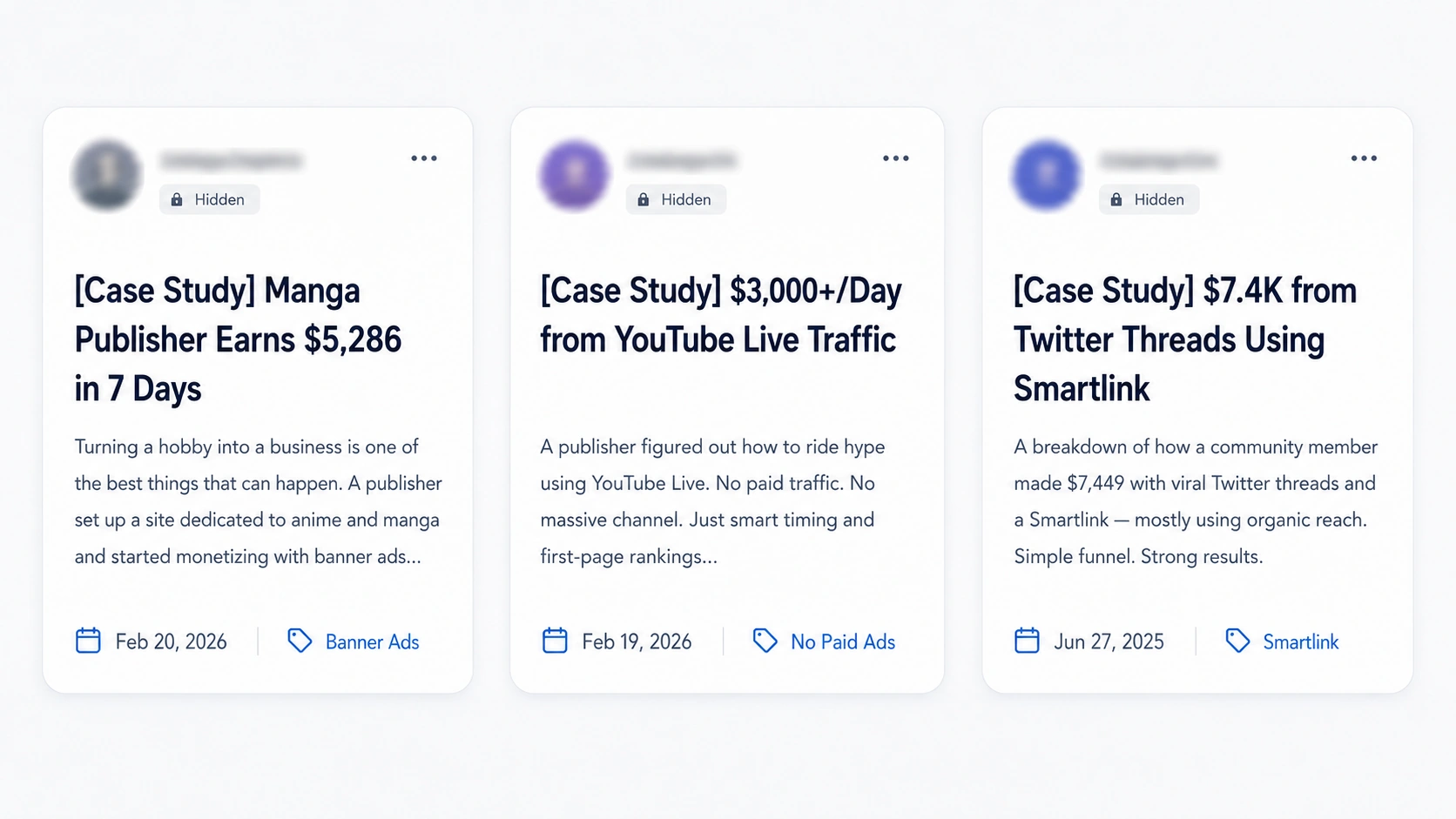
Real case studies. Real traffic angles. Real discussions from affiliates testing what actually works.
See What Real Affiliates Are Discussing